Tuesday, October 11, 2011
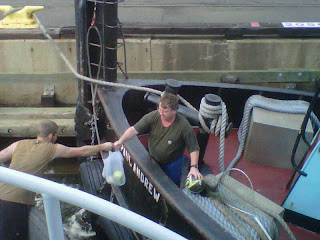
assisting the Caitlin Ann with the Chesapeake 1000.jpg


Wednesday, October 5, 2011
The wrong way

So here's what's wrong: Notice how each line is only hooked on one horn of the cleat? That's no good! People do it, and make a habit of it for a whole career and never get in trouble, but it isn't right. If one of these lines should fail, the boat will slide until the other lines just falls off the cleat, and then we're just hanging on that stern line. the problem with that is two-fold.
As we're making way through the water, we are cramming loads of water between the scow and the boat. These lines are under tremendous strain holding the two vessels together. Now all of a sudden we have nothing there, what happens? The two vessels get pushed apart by this wedge of water, and the only thing holding it all together is the stern line. First of all, we've lost control of the scow. We have no means of steering it. We could put the rudder hard over, bringing the boat back to the scow and doing a big circle until the deckhand gets a couple of lines out - but we need a lot of sea room to get that done. What if there's another boat, or a rock, or some other hazard there? The other problem - and it's a much greater problem - is that as the two vessels separate, they get sideways to the flow of water. They open up like a V. The scow goes one way, the boat goes the other, and now the boat is getting towed by the scow, instead of the other way around. If the scow starts towing the boat sideways, it leans the boat over. we call this getting tripped. The boat leans way over, water gets all over the deck and into any openings, doors, vents, etc..... and starts flooding the boat. Many tugs are lost in this manner. Tugs are built very low to the water, there isn't a lot of freeboard, or reserve buoyancy. You get a little flooding, and it doesn't take much before it's all over.
So why do guys do this the wrong way? It's faster. It's easier than teaching the deckhand about leading the two parts around one end of the cleat and dropping the bight on the other, or even educating them about terms like "the bight" or the "bitter end" versus the "standing part". It's a little easier to get the line off when they are like this too. Take a look at the next post for the right way to do it.
The right way

The right thing about all this is that both lines have a solid purchase on the cleat. We refer to it as a "fore and aft" lead, although it's called different things in different places. If one of theses lines should fail, the other line stays firmly on the cleat. It will be a little slack as the boat slides fore or aft, but I've still got a solid hold on the scow - albeit a little sloppy - until we get a new line out. This is basic good seamanship, pure and simple. Do it right, don't take short cuts, no matter how many times you might get away with it. It's only going to take one time to ruin a perfectly good day, or get someone killed, or even just get you doing a bunch of unpleasant paperwork.
Saturday, July 2, 2011

Sunday, June 5, 2011
 Catherine Turecamo working the stern of the NYK KAI at Port Elixabeth
 Laura K Moran on the bow
 Chicago Bridge at Port Elizabeth
 Chicago Bridge with tugs alongside
This is what we get for scenery these days on the Brian. No big orange ferries, or joggers on the East River. Watching the boats work the ships has got me thinking about my time doing ship assist, in Boston, and for about a year in Philadelphia too.
I liked it because it made me become a better boat handler. The pilot is always expecting a quick response, so one learns how to get it done efficiently. Trying to stay in front of a ship coming out of Chelsea Creek while the deckhand is trying to retrieve your line on the fantail requires finesse and attention to detail for sure. I remember when the craziest, scariest thing was trying to hold the boat in place above the Chelsea St. bridge while waiting for the ship to come through so you could get a line up on the starboard bow. On one side is the channel where the ship is coming, on the other side is the wall of a pump house, where you are trying not to get pushed into. As the ship is coming at you it's pushing a whole bunch of water, which is trying to blow you out of the way. After a while it becomes routine, bump it in and out of gear, hold the boat almost in the way of the ship as it comes, then allow the bow wave to push you aside as you're steering into the ship to land without pushing him around too much.
That was after getting the bare basics down pat. The captain would let you run around light tug, then when he thought you were ready, he'd show you how to come alongside a moving ship. The first time I did that, I came in too hard and knocked everything all over the wheel house. There's some things to know there too, like in anything. I was taught to let the point on the ship, your landing place, to pass you - or at least let it come abeam of you. Then you have to match the boat's speed to the ship. The rest is fairly easy, but it takes a little practice, bring the boat in FLAT alongside the ship. My mistake was that I angled in and landed the shoulder on it, like a lineman laying a block lol. Turn the rudder a little toward the ship, bring the boat in some. Then shift the rudder the other way to flatten out. Keep repeating that a few times till you lay it up alongside gentle as can be. Once your in there, put a little rudder against the ship to keep you pinned without pushing the guy around. Easy as cake.
Wednesday, June 1, 2011
IMG00274-20110601-1709.jpg
Sent on the Sprint® Now Network from my BlackBerry®
Monday, May 30, 2011

Subscribe to:
Posts (Atom)